Showing posts with label compost friendly ideas. Show all posts

Wednesday, October 19, 2011

Compost Friendly Meals

My imaginary readers know that I write a zero waste baby steps blog that talks about how to manage a lifestyle that produces no garbage. Technically I produce waste, but the kind of waste that can be fed into a new life-cycle (everyone remembers technical and biological nutrients, right?). The main form of waste I produce is biological material. I go to the bathroom, I use water, I trim my hair and nails, but most of all, I eat.

When we think about it, cooking makes a lot of garbage. There are cans, bags, wrappers, ties, leftover food, and all the inedible bits that come off of unprocessed food like stems, pits, hulls, peels, and cores. However, garbage from unprocessed food can be composted, while packaged and processed food create waste that at best can be recycled, but at worst ends up entombed for eternity in a landfill. That last statement maybe was a little exaggerated, but really, processed, packaged food isn't good for the planet or you.

At first cooking with plants and whole food can seem complicated and unappetizing, but really it's a simple process that can often be a nice way to unwind after a long day. For example, last night I made my family lentils and rice, Colombian style. Look how yummers it was:

I know it doesn't look its best right now, but I ate it all before I remembered to photograph it, so here you see some of the lovely, package free tomatoes I used to make it, the leftover lentils (I always make twice as much as I need because I love having lentil leftovers), and the broth I spooned off the top which I will use tomorrow to make tomato--carrot soup.

To make it I cooked lentils, while caramelizing onions in a little olive oil. Then I shredded a couple of pounds of tomatoes into the onions, added my secret blend of herbs and spices (and by secret I mean I can't remember what I added because I wing it every time), then mixed the tomatoes and lentils together and let everything cook for a bit together while I spooned broth off the top (not normally part of the process, but I added too much water to the lentils and decided to make the best out of it). I cooked rice while this whole process was going on, then put the lentils on a bed of rice to serve.

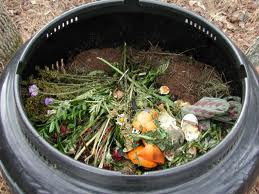
Since I was able to buy the lentils and rice in bulk, this meant that aside from the glass jars the olive oil and spices came in, the meal was zero waste, except for the bits that were collected to be composted:

And there you have it, a healthy, zero waste meal that fed my family and my compost bin. I'm building a little collection of these types of recipes, and I promise to keep you updated on all the delicious news.

Thursday, October 13, 2011

A Friendly Holiday Reminder

As we are all gearing up for the big holiday season I'd like to offer a few reminders, mainly that a lot of holiday decorations and paraphernalia can be composted! I know it's like beating a dead horse, but this site is all about composting, so I don't feel too bad.

Halloween
Carved pumpkins, homemade treats, and decorations made out of paper, cotton cloth, leaves, and wood can all be composted. Let's all make this a compostable haunting holiday. For those of you who know your neighbors (and so have shown them that you're not a crazy child-poisoner), consider giving out homemade treats like cookies, suckers, and popcorn balls. If you have a large neighborhood or aren't that outgoing, consider giving tea lights, coins, feathers, or other trinkets which will delight kids, give grown-up no worries, and are biodegradable or can be considered a technical nutrient.

Thanksgiving
It may be time-intensive, but try making all your treats this year from scratch. Get the whole family involved for a holiday activity that allows everyone to spend time together. Properly store any leftovers, but feel free to compost anything that doesn't get eaten, can't be eaten, or won't be eaten (cooking mistakes, anyone?). Try decorating with leaves, popcorn strings, or flower arrangements that can all be composted. The kids can paint or draw on newspaper, make construction paper cutouts, or form sculptures out of salt dough. All of these make creative, fun, and decorative crafts that can all be composted afterwards. You can even compost the turkey carcass, but try making a delicious broth from it first.

Christmas
I love picking out gifts for people. I love the challenge of finding a person something they'll both love and use, and now I've given myself the challenge of getting them something earth-friendly as well. If you have the money, I recommend getting people a rotating compost bin, as a lot of my family would happily compost if they didn't perceive it as so work intensive. I've been saving up all year to get my parents and in-laws each one of these, but you can also make one yourself for much less money.
Other great Christmas gifts that are less preachy but still good for the environment include lunch containers, furoshiki wraps, second-hand books, and homemade food. While I spend a lot of time picking out the ideal gift for those high on my list, I like to make a big batch of cookies, candy, or nut mix and then individually portion them in compostable waxed bags for all of those who are on my list in big groups, like coworkers, classmates, and the neighborhood.
Remember that a lot of Christmas decorations can be compostable, like your wreaths, garlands, popcorn strings, and even your tree, though you'll want to chop it up first. Wrap your presents in painted newspaper or dyed tissue paper and all the wrappings can be composted as well (don't use tape).
The Christmas card exchange is a wonderful tradition, but there are a multitude of ways to make it earth friendly. You can make your own paper for the cards, send plantable seed cards, stamp your cards with a friendly reminder to recycle, or send the cards to receive to St. Jude's Ranch to be reused and support a good cause.

New Years Eve
Again, make all your decorations out of compostable material, or reuse decorations from last year. Serve drinks and goodies on your standard dinnerware or special occasion china rather than buying plastic utensils and cups. If you want the convenience of throwaway stuff, there's plenty of reusable and compostable options on the market. Just remember that most plastic goods claiming to be biodegradable actually aren't, so opt for things that will obviously break down in your compost bin.
When buying libations for your friends and family, opt for those in glass bottles that can be reused or recycled (If you can't find anyplace else, remember that Target recycles glass). Freeze any leftover wine for cooking if you like, but beer and wine can also be poured on your compost pile and will contribute a flood of good bacteria (the same bacteria that made that grape juice alcoholic in the first place).

I know the holiday rush can be overwhelming, but taking the few extra minutes to pick a compostable option will have a huge payout for your garden come spring, will greatly reduce the trash you have to cart to the curb, and will give you that warm feeling of doing good that we all love to have.

Happy holiday composting!

Tuesday, October 11, 2011

Cradle to Cradle: Waste Equals Food

Not to burden you with too many book reviews in a row, but I just read Cradle to Cradle, by William McDonough and Michael Braungart, and found one concept in their book particularly interesting. The book primarily addresses how products, buildings, and systems can be designed to be beneficial for the earth, the population, and the economy, rather than harmful or just "less bad". It doesn't deal much with composting, but their concept of technical vs. biological nutrients is incredibly relevant.

Ideally, in the human world we would treat our resources like the natural world, where everything cycles through different systems; the waste of one system is food for another. This isn't the case, even when one considers the growing recycling industry, but we could easily make it so by viewing all materials as either technical or biological nutrients. Biological nutrients are things that are compostable and can be fed back into the natural world as a nutritious, safe resource for plants and animals. Technical nutrients are things that can be fed back into the industrial system endlessly to be reused to make new products.

Currently our recycling system is flawed, as much of what we recycle is actually "down-cycled" into products of lesser quality. I definitely need to do more research on this subject, but basically the adding of dyes, paints, or solvents to a material contaminates it when it comes to future use. So if you have a green soda bottle, that plastic is still recyclable, but only as a different, usually lower-quality product.

There are exceptions to this, but system-wide we don't have a good method for recycling materials into products of equal quality and value. Even materials which should be easy to recycle, like metal, are often contaminated because of current recycling methods. For example, aluminum soda cans are often lined in plastic, and cars are crushed into a large block of material, rather than being disassembled to retrieve their copper, steel, and other resources.
I have a whole rant building on how we need to recycle better, design products and packaging with their reuse and recycling in mind, and how the plastics industry is particularly troublesome, but that's an article that needs a lot more thought, research, and calmer state of mind. So what I want to talk about is biological nutrients, and how important it is to separate them out from (what should be) technical nutrients.

As it stands now, unless you participate in some sort of recycling program, technical nutrients and biological nutrients are mixed together in your trash, then buried in the ground at a landfill where they are sealed off from soil and air. What this means is that even the biodegradable waste like banana peels and newspapers won't break down because the right aerobic (or air-loving) bacteria won't grow in this environment, and so there's nothing to facilitate the rotting, or composting, process. I wish every city had a composting program and was vigilant about separating out its waste, but this just isn't the case.

If the city won't do it, it's up to the citizens to make it happen. By all means write letters to your mayor, attend city council meetings, and make phone calls to your city's waste management department, but in the mean time, take matters into your own hands and start composting. Put everything you can into your home compost bin. If you know of neighbors or apartment dwellers who are unable to compost, offer your bin to them as well, it will only enrich your compost and make for a more beautiful world.

I think the idea of technical and biological nutrients is brilliant, and I intend to explore it further. But in the mean time, I know exactly what to do with all my biological nutrients to make sure they are returned safely and responsibly to the earth.